Not all Texas lakefront properties are created equal, and nowhere is that distinction more apparent than on Lake LBJ. While most Texas lakes rise and fall dramatically with rainfall and drought cycles, Lake LBJ holds a rare designation: its water level is actively managed year-round to remain stable. For buyers evaluating Horseshoe Bay, this is not simply a lifestyle perk; it is a measurable, documented driver of property value and long-term investment security. Buyers comparing lakefront markets across Texas need to understand exactly how this works, what premium it commands, and why it matters more than almost any other factor in a waterfront purchase decision. In this blog post, Austin real estate experts Dallas Seely and Amy Seely discuss why Lake LBJ’s constant-level status is one of the most powerful and most misunderstood drivers of Horseshoe Bay property values.
Experience seamless lakeside living with our dedicated property management team. We handle the details so you can enjoy the water.
Key Takeaways
- Lake LBJ is one of the few constant-level lakes in Texas, managed by the Lower Colorado River Authority (LCRA) to maintain a stable elevation target year-round, a rare feature that directly protects and elevates property values in Horseshoe Bay.
- Waterfront properties on Lake LBJ command a significant premium over comparable homes on fluctuating lakes, with lakefront values often running $10,000 or more per linear waterfront foot, a figure that holds even during Texas drought cycles when competing lakes decline.
- Constant water levels protect dock infrastructure, shoreline integrity, and recreational access, all of which are direct contributors to appraised value and buyer demand in Horseshoe Bay.
- Dallas Seely and Amy Seely of The Seely Group have helped buyers navigate the Lake LBJ waterfront market and understand exactly what this premium means for their specific purchase and long-term investment strategy.
To Discuss Your Home Sale or Purchase, Call or Text Today and Start Packing!
Lake LBJ’s constant-level status matters for Horseshoe Bay property values because stable water levels protect every element that makes lakefront real estate valuable: dock access, shoreline integrity, year-round recreational utility, and buyer confidence. Unlike lakes that fluctuate dramatically during drought years, Lake LBJ properties hold their value through Texas weather cycles because the underlying asset, direct, usable water access, never disappears. For buyers and investors evaluating Horseshoe Bay, this distinction is the foundation of the market’s long-term strength.
Having personally lived in communities across the Texas Hill Country, Dallas and Amy Seely bring firsthand waterfront market expertise that most agents cannot match. The Seely Group, ranked in the Top 1% of agents nationwide by Realogy and Top 3 in Central Texas by the Austin Business Journal, has served over 1,000 families across Austin and the surrounding areas. Dallas and Amy understand that buyers evaluating Horseshoe Bay deserve more than general talking points; they deserve a clear, honest explanation of exactly what the constant-level premium means for their investment.
What It Actually Means for a Lake to Be “Constant Level”
Most Texas lakes behave like natural reservoirs; their water levels respond directly to rainfall, evaporation, and regional water demand. During a wet year, the lake rises. During a drought, it can drop dramatically. Lake LBJ operates differently, and that difference starts with a single institution: the Lower Colorado River Authority (LCRA).
How the LCRA Manages Lake LBJ’s Water Level
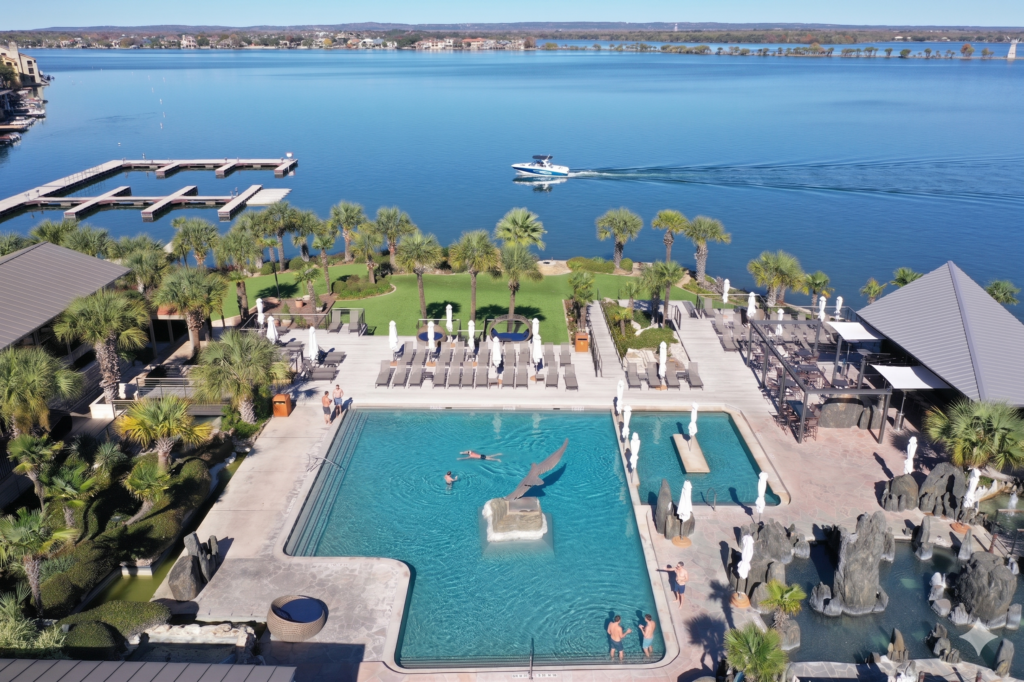
The LCRA manages Lake LBJ to maintain a target elevation of approximately 738 feet above mean sea level (MSL). This is accomplished through the Highland Lakes dam system, which includes Wirtz Dam and Inks Dam, two pieces of infrastructure specifically designed to buffer the effects of drought and heavy rainfall on Lake LBJ’s shoreline. When upstream conditions bring excess water, controlled releases keep the lake from rising out of range. When drought threatens to lower the lake, management of inflows from the dam system protects the stable elevation target.
Extreme flood events, such as the 2018 Llano River flooding, can cause temporary deviations from this target. However, LCRA’s operational mandate is to return the lake to its stable elevation as quickly as conditions allow. That commitment, backed by significant infrastructure investment, is what makes the constant-level designation meaningful; it is not a marketing claim. It is an engineered reality.
One of the most common questions buyers bring to Austin real estate expert Dallas Seely is whether Lake LBJ could ever lose its constant-level status. His answer is consistent:
“Buyers often ask whether Lake LBJ could ever stop being constant level. My answer is always the same: the LCRA’s operational investment in the dam system, the infrastructure, the permits, the management protocols, makes this one of the most durable features of the lake. That stability is exactly why waterfront properties here hold value the way they do, through drought years that test every other lake in Texas.” — Dallas Seely
Understanding this foundation is essential before evaluating any Horseshoe Bay waterfront purchase. The constant-level designation is not a feature that can be added or removed by a developer. It is a product of geography, infrastructure, and regulatory commitment that has been in place for decades.
Lake LBJ vs. Lake Travis: What the Numbers Say About Waterfront Value Stability
For Texas Hill Country waterfront buyers, Lake Travis is the natural comparison point. It is larger, well-known, and located in the same general region. But Lake Travis real estate operates in a fundamentally different water management framework, and that difference shows up in property values precisely when it matters most: during a drought.
Why Drought Years Reveal the Real Value of Constant Level
Lake Travis is a storage reservoir. Its primary purpose is water supply for the greater Austin region, which means its levels fluctuate based on rainfall and regional demand. During the 2011 to 2015 Texas drought, Lake Travis fell to historically low levels, in some years dropping more than 50 feet below full pool. Properties with private docks found them sitting on dry ground or mud. Short-term rental activity declined. Buyers began discounting lakefront properties on Lake Travis because the defining feature, reliable water access, had become unreliable.
During those same years, Lake LBJ’s constant-level management kept Horseshoe Bay waterfront properties at their dock access, recreational utility, and market pricing. The LCRA’s management infrastructure functioned as drought insurance built into the property’s location. Horseshoe Bay lakefront properties continued to command premiums of $10,000 or more per linear waterfront foot, benchmarks that held even as comparable properties on fluctuating lakes faced value pressure.
Lake LBJ is also a smaller, more intimate lake than Lake Travis. That scale contributes to its appeal as a private, boating-focused community setting rather than a large public reservoir. That lifestyle premium compounds the constant-level value advantage, creating a market that attracts buyers seeking both investment security and a refined waterfront experience.
Real estate expert Amy Seely hears the same question consistently from buyers evaluating Horseshoe Bay:
“When buyers ask me why Horseshoe Bay lakefront homes hold such strong premiums, I always come back to the same answer: buyers on a constant-level lake are paying for certainty. Certainty of access, certainty that their dock will be usable, certainty that what they’re buying today will still be a lakefront property five years from now, no matter what Texas weather brings.” — Amy Seely
Lake LBJ vs. Fluctuating Texas Lakes: The Constant-Level Property Value Advantage
| Feature | Lake LBJ (Constant Level) | Fluctuating Texas Lakes |
|---|---|---|
| Water Level Management | LCRA-maintained at stable elevation year-round | Subject to rainfall, drought, and reservoir management variability |
| Dock Infrastructure Impact | Dock remains functional at consistent water access year-round | Risk of dock sitting on dry ground or mud during drought years |
| Shoreline Erosion Risk | Minimized by stable water line; predictable soil conditions | High variability; drought and refill cycles accelerate erosion |
| Property Value Stability | Values hold through Texas drought cycles | Values can decline 15-30%+ during severe multi-year droughts |
| Buyer Confidence Index | High — water access is a known, reliable feature | Variable — buyers discount for uncertainty |
| Waterfront Premium ($/linear ft) | $10,000+ per linear waterfront foot (Horseshoe Bay) | Varies widely; discounted during drought exposure periods |
| Long-Term Investment Security | Strong — rare constant-level designation in Texas | Moderate — weather-dependent value fluctuations |
| Contact The Seely Group For More Information | ||
Frequently Asked Questions
The Lower Colorado River Authority (LCRA) manages Lake LBJ to maintain a target elevation of approximately 738 feet above mean sea level (MSL). This target is actively managed through the Wirtz Dam and Inks Dam system on the Highland Lakes chain. While extreme flood events can cause temporary fluctuations, LCRA’s operational mandate and infrastructure are designed to return the lake to this stable elevation, which is the foundation of Lake LBJ’s constant-level designation.
Because Lake LBJ maintains a predictable water elevation, LCRA dock permits for Horseshoe Bay properties are designed around a known, stable waterline, which simplifies permitting for new dock construction and reduces the risk of docks becoming unusable due to drought. Dock permit costs on Lake LBJ typically range from several hundred to several thousand dollars depending on structure type, with LCRA review timelines generally running 60 to 120 days. Buyers purchasing waterfront properties in Horseshoe Bay should verify whether existing docks are properly permitted and whether any planned improvements require new LCRA approvals.
Horseshoe Bay lakefront properties span a wide range depending on frontage, property type, and position on the lake. Entry-level waterfront condos can start in the mid-$300,000s, while single-family lakefront homes typically range from the low $1 millions into the multi-million dollar tier. Luxury estates and properties with significant linear waterfront footage on prime sections of Lake LBJ have transacted at $10 million and above in recent years. For a current, personalized assessment of what your budget can achieve in the Horseshoe Bay lakefront market, call or text 512.943.2572 today; Dallas Seely and Amy Seely will give you an honest, specific picture of what is available and what it will take to compete in this market.
How Constant Water Levels Drive Property Value: The Specific Mechanisms
Understanding that constant-level status matters is useful. Understanding precisely why it drives value is what separates an informed buyer from one who discovers the details after closing. The connection between stable water levels and property value runs through several specific, measurable channels.
Dock Access, Shoreline Integrity, and Year-Round Recreation
When water levels never change, every feature that makes lakefront real estate valuable stays reliable. That reliability compounds across multiple dimensions of the property's appeal and financial performance. The specific property value drivers that constant-level status protects include:
- Dock infrastructure: Docks are designed around a known, stable waterline. They remain functional and accessible year-round. On fluctuating lakes, docks can sit on dry ground or become structurally compromised by water level swings.
- Shoreline stability: The repeated cycle of drawdown and refill on fluctuating lakes accelerates erosion and destabilizes vegetation. Constant-level shorelines maintain consistent soil conditions and landscaping, protecting both aesthetics and structural integrity near the water's edge.
- Year-round recreational access: Boating, swimming, and water sports are dependable on Lake LBJ. That dependability supports personal enjoyment and short-term rental income for investment buyers.
- Appraisal consistency: Appraisers assess waterfront premiums based on actual water access. A property with guaranteed, year-round water access appraises differently than one on a lake that may sit 30 feet below normal in a drought year.
- Resale confidence: Buyers purchasing a Horseshoe Bay lakefront home know that the feature driving their premium is not weather-dependent. That confidence supports both pricing and days-on-market performance in the resale market.
For buyers evaluating this as a long-term investment, The Seely Group's Austin real estate investing guide provides additional context on how waterfront asset stability factors into broader Central Texas investment strategy. Together, these mechanisms explain why the constant-level designation is not a marketing claim; it is an operational reality that shows up in pricing, lending, and appraisal across the Horseshoe Bay market.
What Horseshoe Bay Buyers Should Know Before Purchasing Lakefront Property
Education about constant-level status is the starting point. The practical due diligence required to purchase a Horseshoe Bay lakefront property goes several layers deeper, and this is where working with an experienced Lake LBJ agent makes a measurable difference.
Navigating LCRA Rules, HOA Structures, and County Jurisdiction
Lake LBJ physically crosses the Llano County and Burnet County line. Properties on different shores fall under different county jurisdictions, which affects property tax rates, building codes, and local zoning rules. This detail surprises many buyers and is rarely covered by competing agents or general informational sources. Confirming which county a target property falls in and understanding the specific regulatory environment is a foundational step in any Horseshoe Bay waterfront search.
Horseshoe Bay has distinct community zones with different HOA and POA structures. Some neighborhoods include direct lakefront access with a private dock easement. Others provide community lake access through a POA amenity. Buyers need to understand exactly what their purchase includes before evaluating the waterfront premium they are paying.
The LCRA's shoreline management program creates a dual regulatory layer on top of HOA restrictions. Any modification to the shoreline or dock structure requires LCRA approval. Buyers with plans for new docks, boathouses, or shoreline landscaping should research this process before closing, not after. Existing docks should be verified for LCRA permit compliance as part of standard due diligence, since unpermitted structures can create complications at the title stage.
Flood insurance requirements also vary by parcel. FEMA flood zone designations differ across Horseshoe Bay waterfront properties, and obtaining an elevation certificate early in the transaction helps buyers understand their insurance obligations and premium range before committing. Learn more about Dallas Seely and Amy Seely and how their experience navigating these layers of due diligence has helped buyers close with confidence across the Lake LBJ waterfront market.
The Long-Term Investment Case for Horseshoe Bay's Constant-Level Waterfront Market
The constant-level advantage, Horseshoe Bay's established resort amenities, and proximity to Austin combine into a multi-layered value proposition that is difficult to replicate anywhere else in Texas. For buyers thinking beyond their first year of ownership, the investment case for this market is compelling.
Why Horseshoe Bay Continues to Attract Buyers from Austin, Houston, and Beyond
Horseshoe Bay sits approximately 65 miles west of Austin via US-281 and TX-71, close enough for a weekend drive, far enough to feel genuinely removed from the city. The community's resort infrastructure, including golf courses, a marina, and resort services, provides a turnkey lifestyle that reinforces property demand independent of short-term market cycles. That infrastructure, combined with reliable lake access, makes this one of the strongest second-home and retirement-home markets in Central Texas.
Short-term rental activity on Lake LBJ is an active segment of the market, though buyers should verify current City of Horseshoe Bay regulations on STRs before purchasing with rental income expectations. The demand exists; the regulatory framework is the variable that requires verification.
The scarcity angle is perhaps the most powerful long-term argument. Constant-level lakes are genuinely rare in Texas. Lake LBJ is one of a small number of lakes in the state with this designation, which means the supply of qualifying waterfront property is permanently constrained. That constraint is a fundamental driver of long-term value appreciation that no developer can replicate or dilute. For buyers exploring the broader landscape of luxury waterfront communities in Texas, Horseshoe Bay stands apart precisely because its core value driver, stable, guaranteed water access, is not replicable elsewhere in the region.
Why Choose The Seely Group to Navigate the Horseshoe Bay Lakefront Market

Purchasing a lakefront home on Lake LBJ is one of the most significant real estate decisions a buyer can make, and it requires an agent who understands the market at the level of LCRA regulations, county jurisdiction nuances, HOA structures, and the pricing mechanics of constant-level waterfront frontage. Dallas Seely and Amy Seely bring that depth to every client conversation, backed by their recognition as the Top 1% of agents nationwide by Realogy and Top 3 in Central Texas by the Austin Business Journal. The Seely Group has served over 1,000 families across Austin and the Texas Hill Country, earning hundreds of 5-Star Google Reviews from buyers and sellers who experienced the difference that genuine local expertise makes. Amy Seely also serves as Austin's #1 ranked CODA/ASL real estate agent, ensuring that every buyer, regardless of communication needs, has full access to The Seely Group's expertise. Whether you are evaluating your first Horseshoe Bay waterfront purchase or comparing Lake LBJ to other Texas lake markets, Dallas and Amy will give you the honest, specific guidance you need to make a sound decision. Learn more about Dallas Seely and Amy Seely and their commitment to helping Texas families create a legacy through real estate.
To Discuss Your Home Sale or Purchase, Call or Text Today and Start Packing!
Stay connected with The Seely Group for the latest Austin and Lake Travis real estate insights, market updates, and luxury home showcases by following us on social media. Connect with us on Instagram, LinkedIn, YouTube, Facebook, and TikTok for expert guidance, virtual home tours, and community updates.
