Purchasing lakefront property in the Texas Hill Country is one of the most rewarding real estate decisions a buyer can make, and Lake LBJ in Horseshoe Bay stands apart from virtually every other waterfront option in Central Texas. Unlike most Texas lakes, Lake LBJ maintains a constant water level managed at 825 feet above mean sea level, making waterfront living on Lake LBJ both predictable and highly desirable for buyers seeking long-term value. However, buying a waterfront home here involves a distinct set of regulatory, financial, and contractual considerations that catch many buyers off guard. From LCRA dock permits and HOA covenants that vary by subdivision to county-specific property taxes and flood zone designations, the complexity of this market rewards buyers who arrive prepared. In this blog post, Austin real estate experts Dallas Seely and Amy Seely discuss what buyers need to know before buying a waterfront property on Lake LBJ in Horseshoe Bay.
Experience seamless lakeside living with our dedicated property management team. We handle the details so you can enjoy the water.
Key Takeaways
- Lake LBJ’s constant water level makes it one of the most stable and desirable waterfront markets in Texas, with Horseshoe Bay properties commanding premium prices — often exceeding $10,000 per linear foot of shoreline.
- LCRA jurisdiction governs all dock and shoreline structures — buyers must verify permit compliance before closing, as unpermitted structures create significant post-purchase liability.
- Property taxes vary significantly by county — Horseshoe Bay properties fall in either Llano or Burnet County, and most waterfront purchases are second homes that do not qualify for homestead exemption.
- Horseshoe Bay Resort membership obligations differ by subdivision — some properties carry mandatory membership fees while others do not, directly affecting carrying costs and resale value.
To Discuss Your Home Sale or Purchase, Call or Text Today and Start Packing!
Before buying a waterfront property on Lake LBJ in Horseshoe Bay, buyers need to understand four critical layers: LCRA permitting rules, subdivision-specific HOA covenants, county tax obligations, and flood zone designations. Lake LBJ’s unique status as a constant-level lake managed by the Lower Colorado River Authority creates both outstanding recreational value and a distinct regulatory framework that differs from most Texas lakes. Working with a local expert who knows Horseshoe Bay is the most efficient path to a successful waterfront purchase.
Having personally lived in Sweetwater and now Serene Hills, Dallas and Amy Seely bring firsthand Lake Travis community experience that most agents simply cannot match. The Seely Group‘s expertise in waterfront properties, new construction, and Lake Travis real estate has helped over 1,000 families find their perfect home. Ranked in the Top 1% of agents nationwide by Realogy, they bring the market depth this complex waterfront market demands.
Why Lake LBJ’s Constant Water Level Changes Everything for Buyers
Most Texas lakes fluctuate significantly based on rainfall, drought cycles, and managed releases, which means docks end up stranded on dry land or submerged depending on the season. Lake LBJ is different. The Lower Colorado River Authority manages the lake at a constant 825-foot elevation, which means buyers can count on consistent dock access, stable shoreline conditions, and predictable recreational use throughout the year. This reliability is the single most important factor driving premium valuations in the Horseshoe Bay waterfront market.
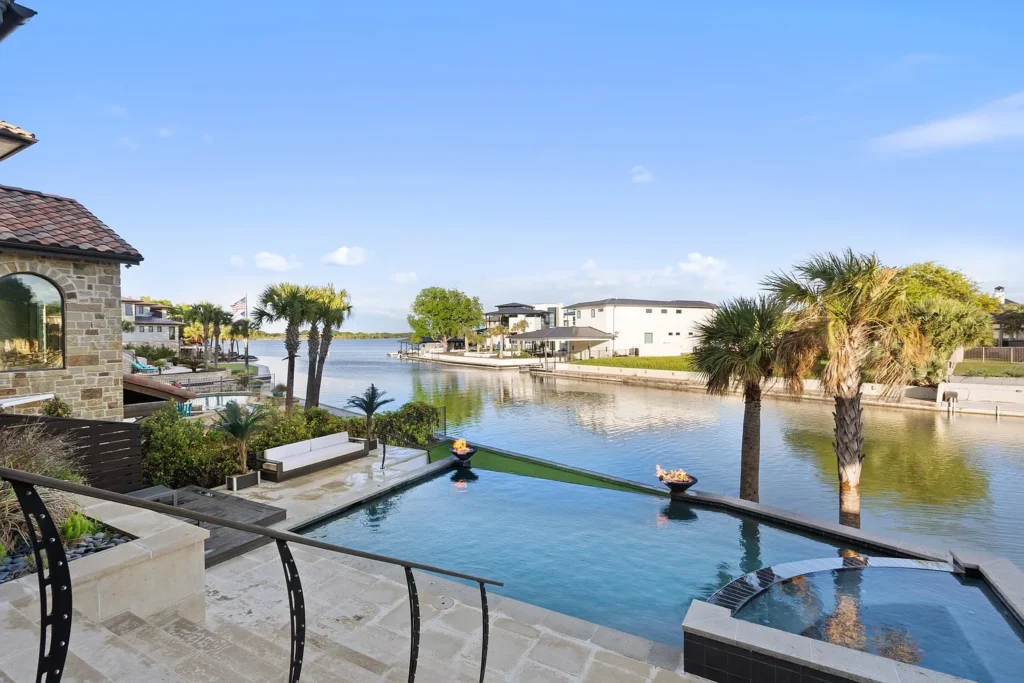
That premium is real and significant. Horseshoe Bay waterfront properties currently command approximately $10,000 or more per linear foot of shoreline, and the market has tracked roughly 8% annual appreciation over recent years. For buyers comparing Lake Travis real estate options with Lake LBJ, the constant water level represents a meaningful value advantage. Lake Travis fluctuates considerably during drought periods, which directly impacts dock usability and waterfront appeal.
“Lake LBJ’s constant water level is the single biggest factor buyers don’t fully appreciate until they’ve looked at other Texas lakes. When the water is always there, so is your investment.” — Austin real estate expert Dallas Seely
How Water Depth and Cove Location Affect Property Value
Even on a constant-level lake, not all waterfront lots are equal. Water depth varies considerably depending on cove location, and shallow coves can limit boat access regardless of the stable surface elevation. Buyers should review a survey to the 825-foot contour line and assess cove depth before making an offer. A property on the open shoreline with deep water access will command a meaningful premium over a comparable home tucked into a shallow cove with seasonal boating limitations.
Understanding LCRA Regulations and Dock Permits on Lake LBJ
The LCRA’s authority extends to all structures at or below the 825-foot contour line, which means buyers do not own to the water’s edge in the way they might assume. Every dock, boathouse, and shoreline modification on Lake LBJ requires a valid LCRA permit. This is not a formality. Buyers who discover unpermitted dock structures during due diligence face a clear choice: negotiate for the seller to obtain compliance before closing, or accept that the liability transfers to them at the moment of purchase.
New residential dock permit applications on Lake LBJ typically take 60 to 120 days for LCRA review and approval. Structures exceeding 1,500 square feet require additional review, which can extend that timeline further. New dock construction costs range from $75,000 to $250,000 or more depending on configuration and LCRA compliance requirements, a budget reality that buyers should factor in from the beginning if the existing dock is non-compliant or absent entirely.
What Happens If You Buy a Property with an Unpermitted Dock?
The short answer is that the problem becomes yours. Sellers are not always forthcoming about permit status, and standard seller disclosures do not reliably capture LCRA compliance issues. Buyers should request the LCRA file for any property as part of due diligence. This is a high-authority step that experienced waterfront agents know to take, but that many buyers’ agents skip entirely. Verifying LCRA compliance before closing protects buyers from inheriting costly remediation obligations on structures they did not build.
Steps to verify LCRA compliance before closing include:
- Request the LCRA permit file from the seller during the Texas Option Period inspection process
- Hire a waterfront-specialist inspector familiar with LCRA compliance requirements in the Highland Lakes area
- Confirm all dock and shoreline structures match the current LCRA permit on file
- Review the survey to the 825-foot contour line to understand actual property boundaries
- Consult with your real estate agent about how non-compliance affects negotiation leverage and purchase price
Horseshoe Bay Waterfront Buying Checklist: Key Factors Before You Close
| Category | What to Verify | Why It Matters |
|---|---|---|
| LCRA Dock Permit | Confirm current permit status; check 825′ contour compliance | Unpermitted structures become buyer’s liability at closing |
| HOA/POA Rules | Request full CC&Rs; confirm STR allowance | Rules vary dramatically by Horseshoe Bay subdivision |
| Resort Membership | Confirm mandatory vs. optional membership status | Affects annual carrying costs and resale appeal |
| Flood Zone | Pull FEMA flood map; request elevation certificate | Zone AE vs. Zone X determines insurance premium range |
| County Tax Jurisdiction | Confirm Llano vs. Burnet County parcel | Tax rates range from 1.12% to 2%+; no homestead on 2nd homes |
| Water Depth & Dock Access | Review survey to 825′ contour line; assess cove depth | Shallow coves limit boat access; affects usability and value |
| STR Permit Status | Check City of Horseshoe Bay STR permit requirements | $600/year city permit required; not all subdivisions allow STRs |
| Texas Option Period | Negotiate 7–10 day option period; order waterfront-specialist inspection | Unique LCRA structures require specialized inspector knowledge |
Frequently Asked Questions
The Lower Colorado River Authority (LCRA) manages Lake LBJ’s water levels and regulates all structures at or below the 825-foot contour line, including boat docks, boathouses, and shoreline modifications. Before buying a waterfront property, buyers must verify that all existing dock and shoreline structures have valid LCRA permits, as unpermitted improvements become the new owner’s responsibility at closing. The LCRA permit review and approval process typically takes 60 to 120 days for new dock applications.
Yes — Lake LBJ is one of the few lakes in Central Texas that maintains a constant water level, managed by the LCRA at a target elevation of 825 feet above mean sea level. This constant level is a primary reason Horseshoe Bay waterfront properties command premium prices, as buyers can depend on consistent dock access, stable shoreline conditions, and predictable recreational use year-round. The constant water level is a significant advantage compared to fluctuating Highland Lakes reservoirs like Lake Travis.
The short answer is that the problem becomes yours. Sellers are not always forthcoming about permit status, and standard seller disclosures do not reliably capture LCRA compliance issues. Buyers should request the LCRA file for any property as part of due diligence. This is a high-authority step that experienced waterfront agents know to take, but that many buyers’ agents skip entirely. Verifying LCRA compliance before closing protects buyers from inheriting costly remediation obligations on structures they did not build.
Buyers purchasing a waterfront property on Lake LBJ as a second home should understand that the Texas homestead exemption, which caps annual assessment increases at 10% for primary residences, does not apply. This means a rapidly appreciating lakefront property can see uncapped increases in its assessed value. Property tax rates across Horseshoe Bay range from approximately 1.12% to over 2% depending on the county, so buyers should review current tax records during the Option Period to understand the gap between assessed value and purchase price.
HOA, POA, and Horseshoe Bay Resort Membership — The Governance Layers Buyers Miss
Horseshoe Bay is not a single, uniform community with one set of rules. The area includes distinct sub-communities, each governed by its own POA or HOA with separate covenants, conditions, and restrictions. Buyers who assume that one set of rules applies across the entire city quickly discover that what is allowed in one subdivision may be prohibited in another. Understanding which sub-community a specific property belongs to is a foundational step in evaluating any waterfront purchase.
The most consequential governance distinction in Horseshoe Bay is the resort membership obligation. Some properties carry mandatory membership fees tied to the resort's amenities. Others do not. Resort membership adds meaningfully to annual carrying costs and should be factored into the total purchase budget before an offer is made. Buyers evaluating luxury waterfront communities across Central Texas should compare these ongoing obligations carefully.
"Many buyers focus entirely on the price and the view, but the CC&Rs and resort membership obligations can add thousands of dollars annually to the cost of ownership. Reading the full covenants before making an offer is non-negotiable." — real estate expert Amy Seely
Short-Term Rental Rules: What the City Allows vs. What Your POA Allows
The City of Horseshoe Bay requires a short-term rental permit at $600 per year for properties used as STRs. However, city approval alone does not override POA-level restrictions. Several Horseshoe Bay subdivisions prohibit short-term rentals entirely at the covenant level. This means a buyer who purchases a property for rental income could find that the POA enforces a complete STR ban regardless of city permitting. Buyers interested in rental income should verify STR allowance at both the city and POA level before proceeding.
Property Taxes, Flood Zones, and the True Cost of Ownership
Horseshoe Bay spans both Llano County and Burnet County, and the county of the specific parcel determines the applicable tax rate. Property tax rates range from approximately 1.12% to over 2%. Most Lake LBJ waterfront purchases are second homes, which means the homestead exemption does not apply. Without homestead protection, a rapidly appreciating waterfront parcel can see uncapped annual assessment increases. Buyers should pull appraisal district records during due diligence to understand current assessed value relative to the purchase price.
Flood zone designation adds another layer to the cost calculation. FEMA designates certain areas as Zone AE (high-risk) while others fall in Zone X (lower risk). Properties in Zone AE require flood insurance when carrying a federally backed mortgage, and premiums have risen significantly in recent years. Buyers should request a flood zone determination and an elevation certificate before finalizing any purchase. Refer to the FEMA Flood Map Service Center and Texas property tax resources for authoritative guidance.
Key costs beyond the purchase price to budget for include:
- Annual HOA/POA dues which vary by subdivision; resort membership properties carry additional annual fees
- LCRA compliance costs for dock permit applications and any required modifications
- Property taxes at 1.12% to 2%+ with no homestead exemption on second homes
- Flood insurance with premiums varying by FEMA zone designation and elevation
- Dock and waterfront maintenance, estimated at $1,500 to $3,000 annually
- Short-term rental permits at $600 per year from the city where applicable
The Texas Due Diligence Process for Lake LBJ Waterfront Buyers
Texas uses a residential contract system where the Option Period gives buyers an unrestricted right to withdraw. For luxury waterfront properties on Lake LBJ, the Option Period is typically 7 to 10 days. Buyers moving to Texas often underestimate how different this process is and how quickly the due diligence window closes.
Waterfront inspections on Lake LBJ require a specialist who understands LCRA structural requirements, dock conditions, and seawall integrity. During the Option Period, buyers should also order a waterfront survey, an LCRA file retrieval to confirm all permits, a flood zone determination, and a thorough review of all HOA and POA governing documents. Buyers should not rely solely on seller disclosures for LCRA or HOA compliance verification.
Why a Waterfront-Specialist Inspector Matters on Lake LBJ
A standard home inspector is not equipped to evaluate the LCRA-specific structural requirements unique to Lake LBJ. Dock framing, boathouse compliance, seawall condition, and shoreline erosion all require a specialist's eye. Hiring the right inspector is one of the highest-value decisions a buyer can make, and it is one area where an experienced waterfront expert like Dallas Seely can provide direct referrals from a trusted professional network.
Why Choose The Seely Group to Guide Your Lake LBJ Waterfront Purchase

Navigating a waterfront purchase on Lake LBJ in Horseshoe Bay requires deep knowledge of LCRA regulations, subdivision-level HOA distinctions, and the luxury market dynamics that drive value. Dallas Seely and Amy Seely lead The Seely Group, ranked in the Top 1% of agents nationwide by Realogy and Top 3 in Central Texas by the Austin Business Journal, with over 1,000 families served. Their firsthand experience living in Texas Hill Country communities gives them the on-the-ground perspective buyers need. The Seely Group has earned hundreds of 5-Star Google Reviews from clients who value expert guidance and a relationships-over-transactions approach. Amy Seely is also recognized as Austin's #1 ranked CODA/ASL real estate agent in Central Texas, ensuring full accessibility. As a top realtor in Austin, The Seely Group brings the Austin luxury real estate expertise that Lake LBJ buyers deserve. Call or text them today for help. Learn more about Dallas Seely and Amy Seely and their commitment to helping Austin families create a legacy through real estate.
To Discuss Your Home Sale or Purchase, Call or Text Today and Start Packing!
Stay connected with The Seely Group for the latest Austin and Lake Travis real estate insights, market updates, and luxury home showcases by following us on social media. Connect with us on Instagram, LinkedIn, YouTube, Facebook, and TikTok for expert guidance, virtual home tours, and community updates.
